TikTok Ads Dayparting Schedule: Fix Budget Pacing Traps
Master TikTok ads dayparting schedule and budget pacing. Stop morning budget drains, align time zones, and protect prime conversion hours with automated rules.
You open your TikTok Ads Manager dashboard at 10:00 AM, coffee in hand, ready to review morning conversions. Instead, a glaring red status badge greets you: "Out of Campaign Budget." Without a calibrated TikTok ads dayparting schedule, your daily allocation of $500 evaporated in under four hours while conversion rates hovered at near-zero levels. Worse, your high-converting evening shopping window between 19:00 and 23:00 has zero dollars left to deploy.
This scenario represents the classic budget front-loading trap. Every month, direct-to-consumer (DTC) brands and TikTok Shop merchants burn thousands of dollars because the platform's default pacing algorithm prioritizes volume fulfillment over conversion timing. When advertisers try to fix this with native dayparting, they often introduce fresh problems: broken time zone alignments, auction liquidity freezes, and repeated learning phase resets.
If you frequently run into exhausted limits before peak demand windows, review our Out of Campaign Budget guide to resolve account-level allocation caps. Fixing your delivery curve requires understanding the mechanics behind the TikTok pacing engine, restructuring your schedule around true audience behavior, and deploying automated guardrails that protect capital without strangling delivery.
Why TikTok Ads Drain Daily Budgets Too Early
TikTok's auction delivery system operates on predictive clearing models. Unlike search ads where delivery waits for user intent queries, TikTok serves impressions across an endless algorithmic feed. To ensure campaigns spend their full daily budget, the bidding system calculates an internal pacing multiplier based on historical inventory density and real-time competitor bids.
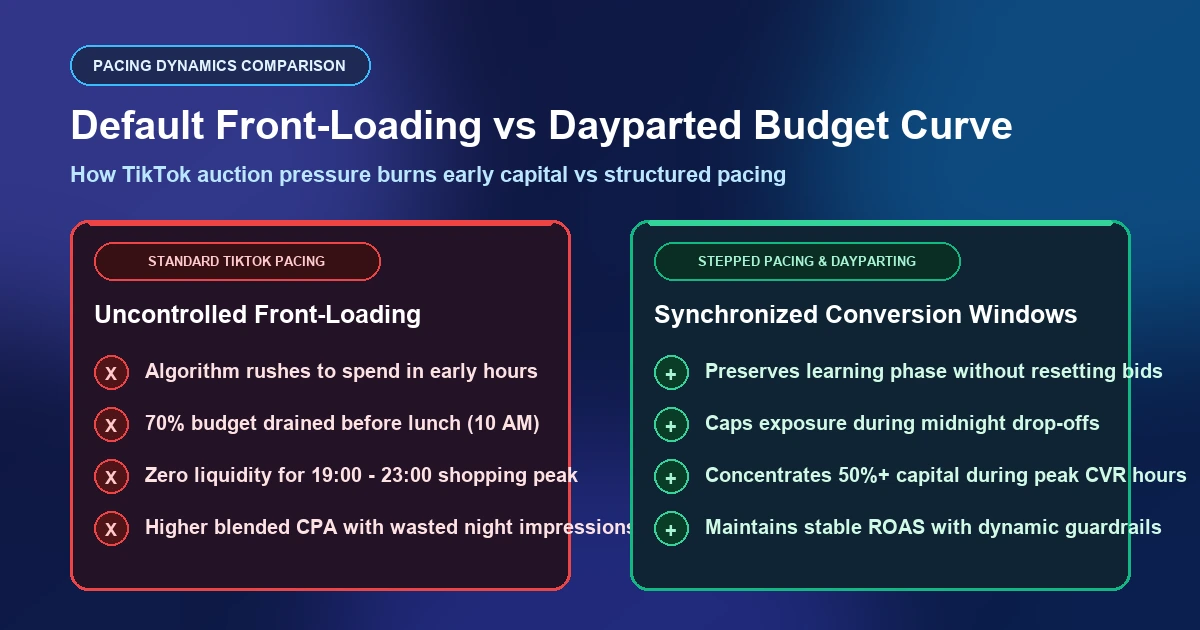
In the early morning hours between 00:00 and 06:00, auction competition dips. Fewer advertisers compete aggressively for midnight ad slots, lowering CPMs across open inventory. TikTok's delivery engine registers these lower CPMs as an opportunity to secure cheap impressions quickly. If your campaign uses standard delivery under Lowest Cost bidding, the pacing engine ramps impression velocity rapidly, burning 60% to 75% of your daily capital before noon.
The core breakdown stems from a fundamental disconnect: cheap impressions do not equal qualified buyers. While casual scrollers browse TikTok in bed at 2:00 AM, add-to-cart velocity and checkout completion rates plummet during late-night and early morning hours. By consuming liquidity during low-intent windows, the algorithm leaves campaigns starved of budget precisely when high-intent shoppers browse during evening commute and leisure hours.
The Structural Flaws of Native Dayparting Settings
Most media buyers attempt to configure a TikTok ads dayparting schedule to counter early morning spend drains by switching ad groups from "All Day" to native "Dayparting" in TikTok Ads Manager. They select specific hour blocks on the scheduling grid and block out midnight through early morning.
While this approach appears logical on paper, native dayparting carries three systemic structural flaws that frequently damage campaign performance.
1. Ad Account Time Zone Misalignment
TikTok schedules dayparting strictly according to the time zone selected when creating your Business Center or Ad Account, not the local time zone of the person watching your video.
If your ad account is registered in Eastern Time (UTC-5) but targets shoppers across the United States, including Pacific Time (UTC-8), a dayparting window configured to run from 18:00 to 23:00 will shut down at 20:00 for California buyers. For cross-border sellers running UK accounts targeting US consumers, or Singapore entities targeting Europe, an uncorrected time zone offset creates complete inversion: your ads run when your target audience sleeps and pause when they pull out their credit cards.
2. Micro-Slicing and the Liquidity Freeze
When media buyers aggressively chop their schedules into fragmented two-hour pockets, such as running from 11:00 to 13:00, pausing until 17:00, and resuming until 21:00, they trigger an auction liquidity freeze.
TikTok's delivery engine requires an initial exploratory runway of 45 to 90 minutes each time an ad group reactivates. During this warm-up window, the algorithm tests bid competitiveness across active auction pools. If the active window lasts only two hours, the campaign spends half its window in exploration before reaching steady-state delivery, resulting in erratic CPM spikes and suppressed delivery volume.
3. Frequent State Toggles and Bid Window Destabilization
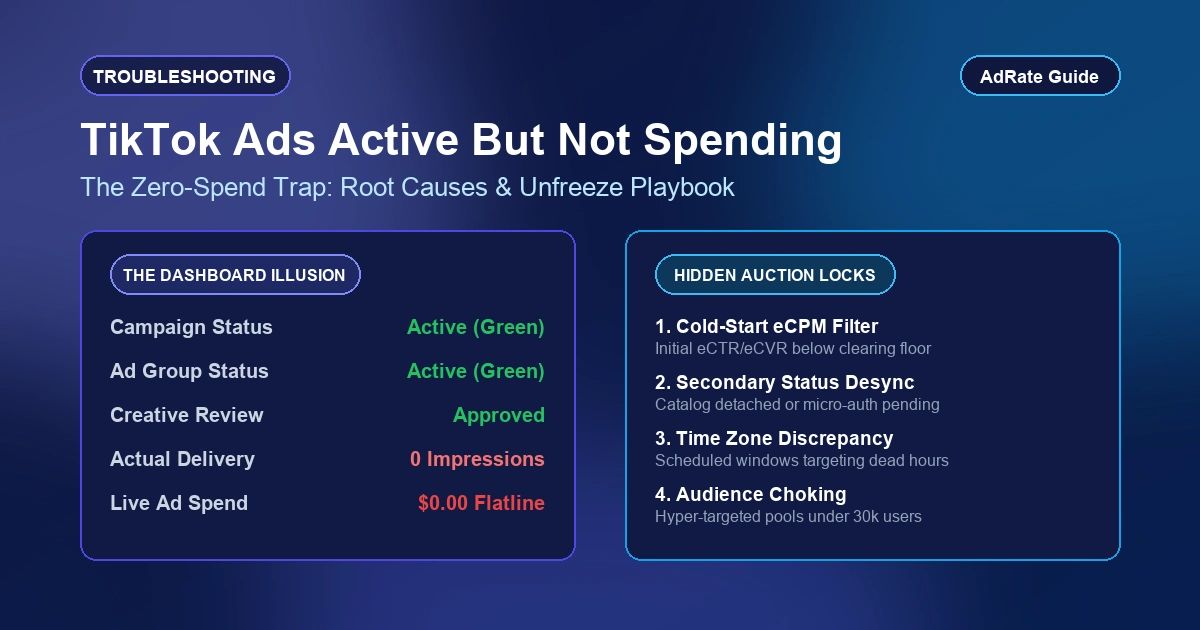
Repeatedly turning ad groups on and off throughout the day resets real-time auction feedback loops. While scheduled dayparting within an existing ad group is officially supported, abrupt delivery cutoffs disrupt pixel signal flow. If an ad receives several conversions right before a forced pause, the algorithm loses the momentum to find lookalike auction pockets while conversion intent remains fresh. Over-restricting delivery can stall momentum completely; if campaigns freeze and fail to spend, consult our practical breakdown on troubleshooting zero-spend traps.
| Delivery Approach | Budget Distribution | Time Zone Dependency | Impact on Learning Stability |
|---|---|---|---|
| Native All-Day Standard | Heavily front-loaded before noon | Follows account UTC | High volume, but poor peak alignment |
| Native Grid Dayparting | Restricted to fixed hours | Fixed to account timezone | Frequent auction warm-up delays |
| Stepped Budget Pacing | Dynamic allocation across windows | Normalized to audience timezone | Preserves continuous learning momentum |
The Mechanics of Dynamic Pacing: Smoothing vs. Stepped Ladders
To optimize capital allocation without choking delivery, advertisers must choose between algorithmic pacing smoothing and dynamic stepped budget scheduling.
Algorithmic budget smoothing aims to distribute daily spend evenly across 24 hours. While smoothing eliminates abrupt morning burnouts, it treats all hours equally. Spending $20 per hour at 4:00 AM when checkout intent is low yields far worse return on ad spend (ROAS) than deploying that same $20 at 20:00 when conversion rates peak.
The superior strategy is a stepped budget ladder. Instead of completely turning off campaigns during off-peak hours, you maintain a baseline budget floor that sustains auction signals and audience liquidity. As high-intent shopping windows approach, you systematically elevate budget allocations or bid caps to absorb peak buyer traffic, tapering capital back down once the buying window closes.
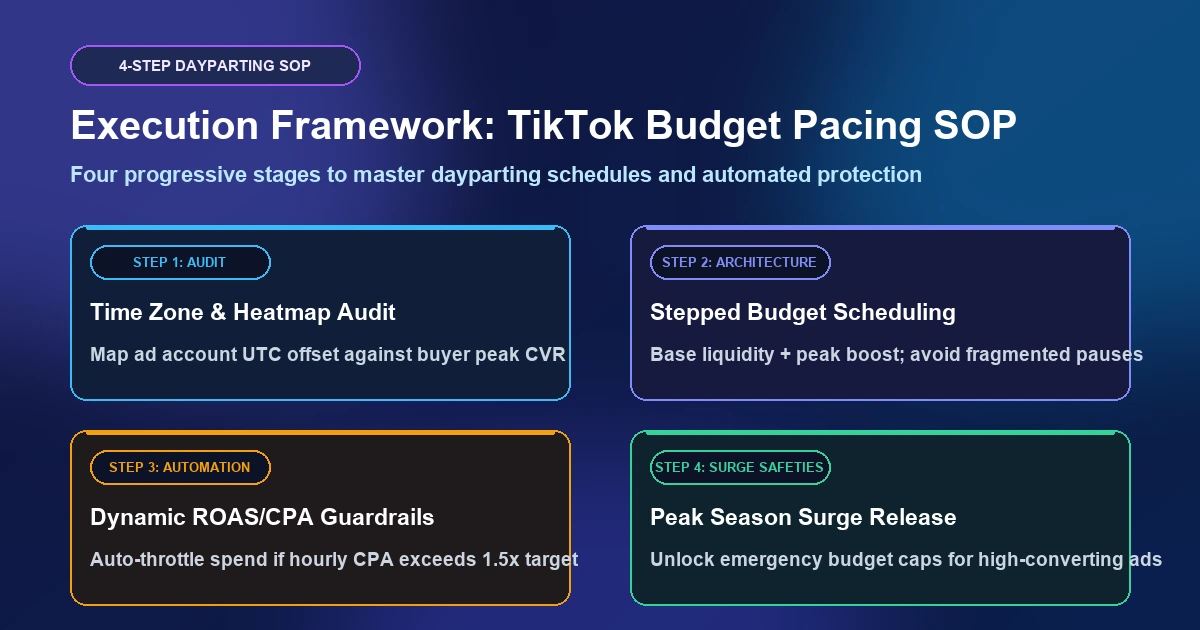
4-Step Operational SOP for TikTok Dayparting and Budget Pacing
Implementing an effective dayparting architecture requires disciplined execution. Follow this four-step standard operating procedure to synchronize spend velocity with customer conversion cycles.
Step 1: Normalize Time Zones and Audit Audience Conversion Heatmaps
Before modifying any scheduling settings, establish an accurate conversion baseline by mapping your customer purchase behavior against ad account timestamps.
- Calculate the UTC Delta: Identify your TikTok Ad Account time zone in Business Center settings and compare it against your primary customer geography. If your ad account is UTC+0 and 80% of your customer base resides in US Central Time (UTC-6), your baseline operational offset is minus 6 hours.
- Export Hourly Conversion Heatmaps: Extract at least 30 days of purchase transaction data from your store analytics or backend order management system. Group completed orders by day of week and customer local hour.
- Isolate Prime Conversion Windows (CVR Peaks): For most e-commerce and retail categories, conversion volume concentrates in two distinct waves: the midday lunch window (12:00 to 14:00 local time) and the prime evening shopping block (18:30 to 22:30 local time). Late-night hours (01:00 to 07:00) typically demonstrate high click-through rates but significantly lower conversion rates.
- Translate Buyer Windows into Account Schedule Hours: Shift your target buyer windows by the UTC delta to determine the exact hours to configure in your ad account.
Step 2: Build a Stepped Dayparting Campaign Architecture
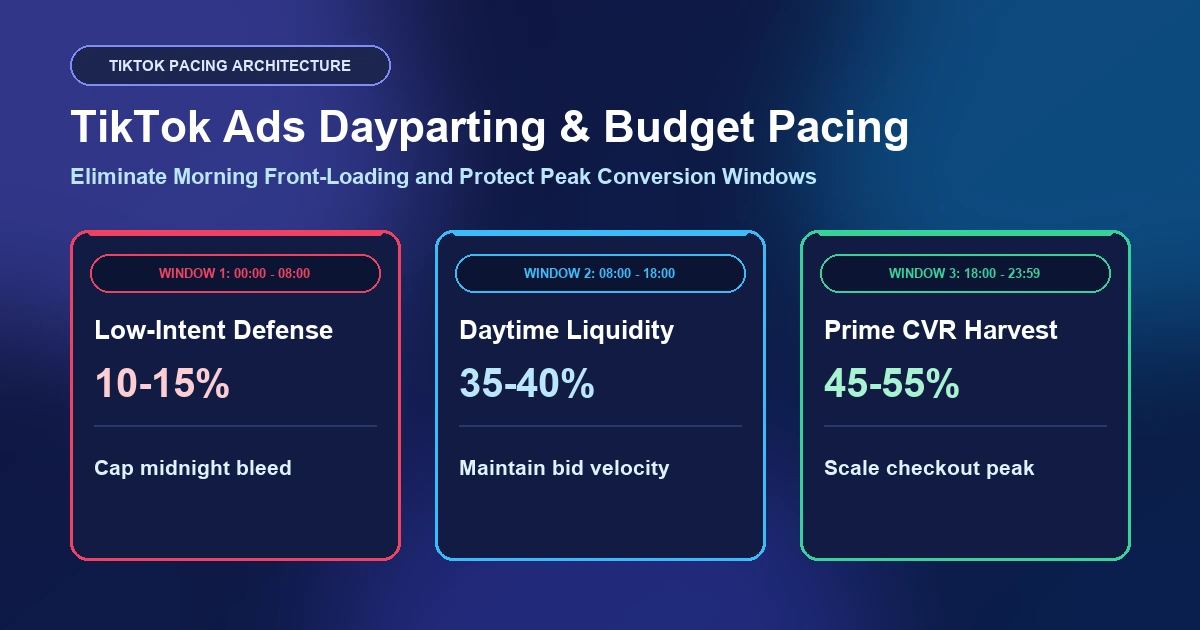
Avoid rigid binary toggles when structuring your TikTok ads dayparting schedule. Instead of cutting ad group activity completely, distribute your daily campaign spend using a stepped allocation framework across three primary operating phases:
- Phase 1: Defense and Signal Preservation (00:00 - 08:00 Local Time): Allocate 10% to 15% of total daily budget. Maintain delivery at reduced pace rather than hard-pausing. This preserves pixel event freshness and maintains auction indexing while preventing aggressive early drains.
- Phase 2: Daytime Liquidity Building (08:00 - 18:00 Local Time): Allocate 35% to 40% of daily capital. Capture growing daytime mobile engagement, lunchtime impulse purchases, and afternoon consideration searches.
- Phase 3: Prime Conversion Harvest (18:00 - 23:59 Local Time): Deploy 45% to 55% of your budget. Drive maximum delivery during peak leisure hours when users relax at home and complete checkout flows.
[00:00 - 08:00 Defense Window] ──> Base Spend Floor (10-15% Budget)
                                         │
[08:00 - 18:00 Daytime Ramp]    ──> Expanded Delivery (35-40% Budget)
                                         │
[18:00 - 23:59 Harvest Window]  ──> Peak Scaling (45-55% Budget)
By transitioning between phases with gradual budget adjustments rather than hard status toggles, your ad groups maintain uninterrupted algorithmic delivery while concentrating purchasing power where it delivers the highest return.
Step 3: Implement Automated Guardrails and Dynamic Speed Limits
Manual budget adjustments across multiple ad accounts and campaigns are slow and prone to human delay. If an ad group runs into runaway spend or sudden creative fatigue early in the day, waiting hours to intervene can waste hundreds of dollars.
Deploying conditional automated rules ensures real-time protection around the clock. By establishing clear "if-then" criteria, you protect your capital automatically:
- Morning Spend Velocity Brake: If an ad group spends more than 25% of its daily budget before 09:00 with zero attributed purchases, automatically throttle its daily budget by 30% or apply a temporary pause until the afternoon session.
- Hourly CPA Runaway Gate: If real-time cost per acquisition (CPA) over the last 2 hours exceeds 1.5x your target threshold, scale back the ad group budget or lower its bid ceiling.
- Mid-Flight Budget Injection: When an ad group demonstrates strong ROAS (e.g., greater than 2.8x target) and has consumed 80% of its allocation by 19:00, automatically increase the budget by 20% to capture remaining evening demand without manual oversight.
| Guardrail Objective | Trigger Condition | Automated Action | Frequency |
|---|---|---|---|
| Prevent Midnight Bleed | Spend > $50 AND Conversions = 0 between 00:00-06:00 | Pause ad group or cut budget 40% | Every 15 minutes |
| Dynamic Mid-Day Brake | Today's CPA > 1.4x Target AND Spend > $150 | Reduce budget by 25% | Hourly check |
| Peak Window Scale | Last 4h ROAS > 2.5x AND Budget Remaining < 20% | Increase budget by 20% | Every 30 minutes |
| End-of-Day Reset | Daily reset at 23:59 account time | Reset budget to baseline allocation | Daily |
Step 4: Scale Safely During Peak Commercial Holidays
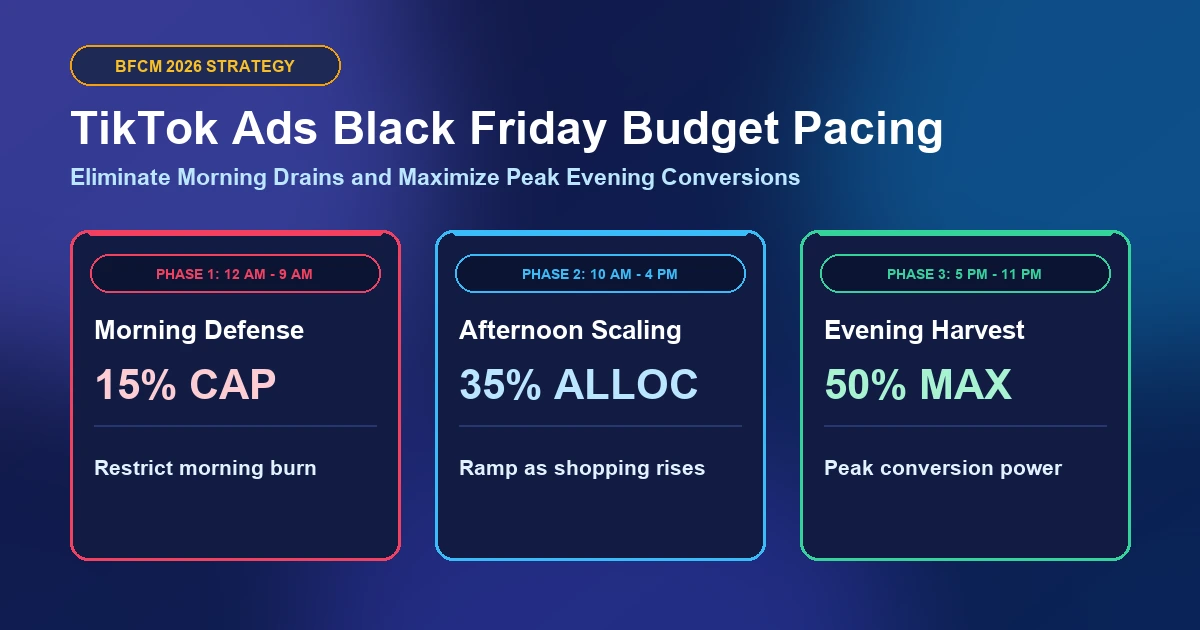
During peak shopping surges like Black Friday Cyber Monday (BFCM) or Q4 flash sales, traffic density and auction competition escalate dramatically. Standard delivery settings can drain a $5,000 budget in ninety minutes as thousands of retail brands bid aggressively for the same impressions. Implementing specialized BFCM budget pacing strategies alongside dayparting preserves capital for high-volume conversion spikes.
To survive and profit during high-volume spikes:
- Deploy Emergency Circuit Breakers: Establish hard stopping rules that monitor conversion velocity. If the checkout conversion rate drops below 1.2% over any 90-minute stretch while ad spend accelerates by more than 50% hour-over-hour, trigger an automated notification or momentary spend cap.
- Deploy Accelerated Delivery Selectively: Reserve accelerated pacing exclusively for narrow flash sale windows (such as a 2-hour 50% discount) where rapid impression volume outweighs cost predictability. For standard catalog sales, maintain stepped Lowest Cost pacing.
- Pre-Authorize Evening Budget Headroom: During holiday sales, evening conversion spikes can double standard volume. Ensure high-performing ad sets have pre-configured expansion rules that unlock extra budget headroom once baseline daily allocations are exhausted.
Protecting Margins with AdRate Automation
Executing an active TikTok ads dayparting schedule and dynamic pacing manually across dozens of campaigns creates severe operational bottlenecks. Pitching bids at 8:00 AM, scaling budgets at 18:30, and reducing limits at midnight forces media buyers into round-the-clock manual monitoring.
AdRate solves this friction by providing a 24/7 automation engine built specifically for TikTok advertising teams and cross-border brands. With AdRate, you eliminate manual dashboard management through robust, flexible guardrails:
- Multi-Pipeline Conditional Rules: Construct sophisticated branching logic combining real-time metrics, budget utilization percentages, and time-of-day filters. Set rules that cut off midnight budget bleeds while preserving winning ads during peak shopping hours.
- Granular Control Across Campaign, Ad Group, and Ad Levels: Apply budget shifts at the campaign level, adjust bids at the ad group level, or trigger creative rotation at the ad level from a unified control panel.
- Tag-Based Dynamic Target Binding: Assign operational labels like "US High-Budget" or "EU Scale" to ad accounts. AdRate rules automatically attach to newly created campaigns bearing the tag, eliminating repetitive setup across new ad sets.
- Rapid Execution Frequencies: Run checks as frequently as every minute on premium plans, catching runaway morning spend spikes before they exhaust daily capital.
By synchronizing your dayparting schedules with real consumer purchasing habits and enforcing automated budget guardrails, you transform TikTok from an unpredictable money drain into a controlled, high-margin revenue engine.
Ready to stop morning budget burns and protect your peak conversion windows? Start your 7-day free trial on AdRate today, or visit www.adrate.io to explore automated budget pacing guardrails.
Official TikTok new advertiser program - exclusive benefits for new advertisers
Open a new TikTok ad account and earn official ad credit as you spend
Spend $200 within 30 days of signing up and get $200 in ad credit, rising to $6,000 when you spend $10,000. Credits go straight into your TikTok ad campaigns.
Coupons are issued by TikTok once it confirms you qualify as a new advertiser. Actual issuance and tiers are shown on the Coupon Progress page inside your TikTok Ads account.